The short answer is… no. Wood is not always heavier. We use our Gloomhaven organizer to bust that myth.
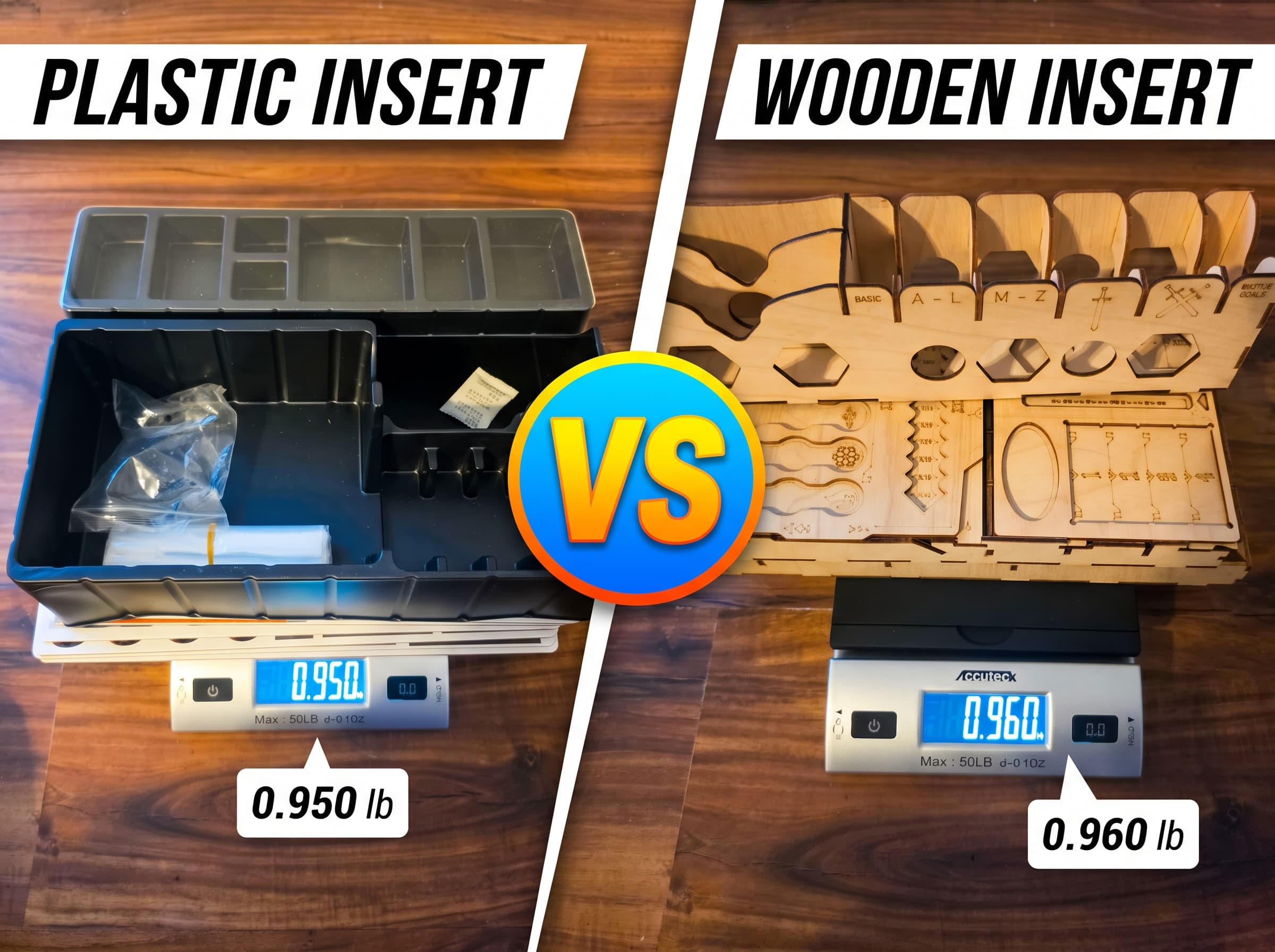
Boardgame wooden inserts are not always heavier. Our Gloomhaven organizer for Jaws of the Lion adds just 0.010 lbs to the box. That's about 4.5 grams.
It surprises people, because one of the most common beliefs in the organizer world is that wood is always the heavy option when compared to 3D-printed plastic. Ask in any board game forum and you'll hear it: wood looks great and premium, but your box will turn into a brick.
That belief isn't completely wrong. Some wooden inserts really are heavy. But the reason has less to do with wood itself and more to do with two things most people never look at: 1) Which specific wood material is being used, and 2) How much of it the designer really needs to use to get your game organized.
Every material has its own pros and cons. While foam core clearly wins on pure lightness, we decided to focus this showdown strictly on comparing wooden inserts against other kinds of "woods" and 3D-printed plastic.
Not all "wood" is the same wood
Most budget wooden inserts aren't made from solid wood or plywood. They're made from MDF (medium-density fiberboard) or, more commonly, HDF (high-density fiberboard): wood fibers pressed together with resin. Technically, they aren’t actually wood but rather a wood-based composite. They cut cleanly and cost less, which is why they're everywhere.
The trade-off is weight. Fiberboard is dense by design, and HDF is the densest of the common options. While we acknowledge the MDF and HDF are good for certain properties, mass density is certainly not one of them.
Here is a quick comparison chart
Material | Typical density (kg/m³) | What it is |
HDF | 800–1,040* | Wood fibers compressed with resin at high pressure |
MDF | 600–800* | Wood fibers bonded with resin |
Baltic birch plywood | ~680–700* | Thin layers of real birch veneer, cross-laminated |
*Ranges are typical published values and vary by manufacturer and thickness.
Baltic birch is clearly lighter than HDF, and sits at the lighter end of the MDF range. Where it pulls ahead is everything else. It's real wood, with visible grain that takes stain and engraving beautifully. It holds a friction-fit joint without crumbling at the edges. And it's stiff enough that we can cut thinner walls without the piece falling apart, which is where real weight savings start.
Think in these terms: If MDF and HDF are cast iron, Baltic birch is titanium: strength without the bulk.
Plastic isn't light by nature either
The plastics used in 3D printing are denser than Baltic birch. Solid PLA is about 1,240 kg/m³ and PETG about 1,270 kg/m³, nearly double the density of birch plywood.
3D-printed inserts feel light because they aren't solid. Printers build hollow walls with a sparse internal pattern called infill, often 10–20%. That's a design choice, not a property of plastic. Printing also allows thinner walls. A printed divider can go down to around 1–1.5 mm, while laser-cut plywood is usually limited to 1/8" (3 mm) per wall. With walls that thin and mostly hollow, a printed insert can come out lighter than a wooden one with the same layout. The trade-off is rigidity: thin printed walls flex more and are weakest between layers, where they tend to crack.
Which brings us to the real point: whether the insert is wood or plastic, its weight is decided mostly by how much material the design puts in the box.
If we compare only the material density and use them in the exact same design, cubic inch by cubic inch, a wooden insert made from Baltic Birch will easily come out on top.
Case study: Gloomhaven organizer Jaws of the Lion
We put it on the scale. First, we weighed everything our Gloomhaven organizer replaces: the original plastic insert, the baggies, and the punched cardboard sheets. Then we weighed our boardgame wooden insert made from Baltic Birch.
What we weighed | Weight (lbs) |
Removed: original plastic insert, baggies, punched cardboard | 0.950 |
Added: Knightsmiths Gloomhaven organizer (wood insert) | 0.960 |
Net change to the box | +0.010 |
Net result: 0.010 lbs, roughly 4.5 grams. For a complete organizer that sorts every component, keeps cards sleeve-ready, includes elemental, round, and initiative trackers built in, and still allows the lid to close flush, it’s essentially no change from the original box as shipped.
Ok, hold a sec! You might be wondering "but you’re counting the punched leftover cardboards, which I’m going to get rid of anyway." That's true, we are. However, we’re simply removing everything that needs to be removed and accounting for everything we’ll be adding. That way we better understand how much real burden is being added beyond the original box weight. For comparison purposes, the punched cardboards weight is 0.335 lbs, about 152 g.
Three modules. That’s it.
Our Gloomhaven organizer has a deck holder for every card in the game, sleeve-ready and Two token and component trays that hold everything else.
The two trays are where less becomes more, literally. Their lids aren’t just lids. They work as an Element Tracker, an Initiative Tracker and a Round Tracker at the table.
Those are three accessories most players end up buying separately. Each one is another object in the box. It's not just burden in terms of weight; it's another hit on your wallet as well. That's why we built them into pieces you already need, so they cost you nothing in extra weight, space or $$$.
In our Gloomhaven organizer you have three modules doing the work of several. Three modules doing more than just organizing tokens. That’s how a wooden insert ends up weighing the same as the cardboard and plastic it replaces and costing you way less than purchasing everything separately.
The bottom line
A board game’s wooden insert isn’t automatically the heaviest option. HDF can be, oversized designs can be, and many-tray setups can be too... almost any material can!
It’s always about design choices and using the material’s properties to work with the player, not against them.
When comparing organizers, skip the “wood vs. plastic” debate and ask better questions: Is it made from real plywood or fiberboard? Does the design use the material thoughtfully, or is it just cramming boxes into a larger box? How many pieces are needed to get the job done?
At Knightsmiths, our answers are simple: we use Baltic birch and try to design with as few moving pieces as possible. Our solutions should, whenever possible, do more than just organize. They should deliver more function in less footprint, and when it comes to a Gloomhaven organizer, a box that weighs about the same as it did the day you unpacked the game.
Share your thoughts on other board games that deserve a wooden insert offering a full-service solution: storage, organization, gameplay enhancement, and more importantly: delivering it all in a lightweight design.
From your gamer friends at Knightsmiths